
To build a discipline routine that sticks, stop trying harder and engineer a chain instead: stack each new habit onto an existing one, anchor it to a stable cue with an if-then plan, run a 15-minute weekly review, and execute a reduced version rather than skipping when life disrupts you.
Most people try to be more disciplined by trying harder. That does not last. What works is a discipline routine: a fixed sequence of behaviors anchored to stable cues. In a real-world study of 96 people, Lally et al. (2010, European Journal of Social Psychology) found a behavior took a median of 66 days to become automatic. Design the routine correctly and you stop relying on motivation. This page shows you how.
What a Discipline Routine Really Is
A discipline routine is not a schedule. It is a chain of behaviors where each link triggers the next. The science behind this is clear. Habits migrate from the decision-making prefrontal cortex to the habit-storage basal ganglia with enough repetition. Once that migration happens, the behavior runs automatically with almost no mental effort.
Research tracking 96 people over 84 days found the median time for a behavior to become automatic was 66 days. Not 21 days. Not a week. Sixty-six days, with a range of 18 to 254 days depending on how complex the behavior is.
The goal is not to grind harder every morning. The goal is to build a system where the right behaviors happen without a fight. That takes time, a clear structure, and one or two simple tools.
Build Your Routine with Habit Stacking
The fastest way to add a new behavior to your routine is to attach it to something you already do reliably. This is called habit stacking.
The Stacking Formula
The formula is simple: after I do [existing habit], I will do [new habit].
- After I pour my morning coffee, I will review my top three priorities for the day.
- After I sit at my desk, I will close all browser tabs except the one I am working in.
- After I finish lunch, I will take a 10-minute walk.
The existing habit acts as a guaranteed cue. You do not need to remember the new behavior. You do not need to feel motivated. The sequence fires because the trigger fires.
Start with one stack. Add a second only after the first feels automatic, typically after 60 or more days. Adding too many habits at once splits your attention and makes each one weaker.
Lock In Cues: Make the Routine Automatic
Every habit in your routine needs a stable cue: a consistent time, place, or trigger that tells your brain it is time to act. In a diary study, Wood, Quinn, and Kashy (2002, Journal of Personality and Social Psychology) found that roughly 43 percent of daily behaviors were repeated almost every day in the same location, driven by environmental cues rather than conscious decisions. Your environment is already running most of your day. Design it deliberately.
Designing Reliable Cues
A reliable cue has three qualities. It is specific (a time or place, not a vague intention). It is consistent (it happens the same way every day). And it is visible (your brain can detect it without effort).
- Time cue: 6:00 AM alarm goes off. Workout clothes are already laid out. You put them on before thinking.
- Location cue: Sitting at your desk means deep work mode. Phone goes face-down before you open the laptop.
- Action cue: After brushing teeth at night, you write tomorrow's top three tasks in your planner.
In a meta-analysis of 94 independent studies, Gollwitzer and Sheeran (2006) found that writing your cue-behavior pair as an if-then “implementation intention” had a medium-to-large effect on goal attainment (d = 0.65). That effect size is strong enough to call it the single highest-leverage tool in the discipline toolkit. Write yours down. “When X happens, I will do Y.”
The Weekly Review: Audit Your System
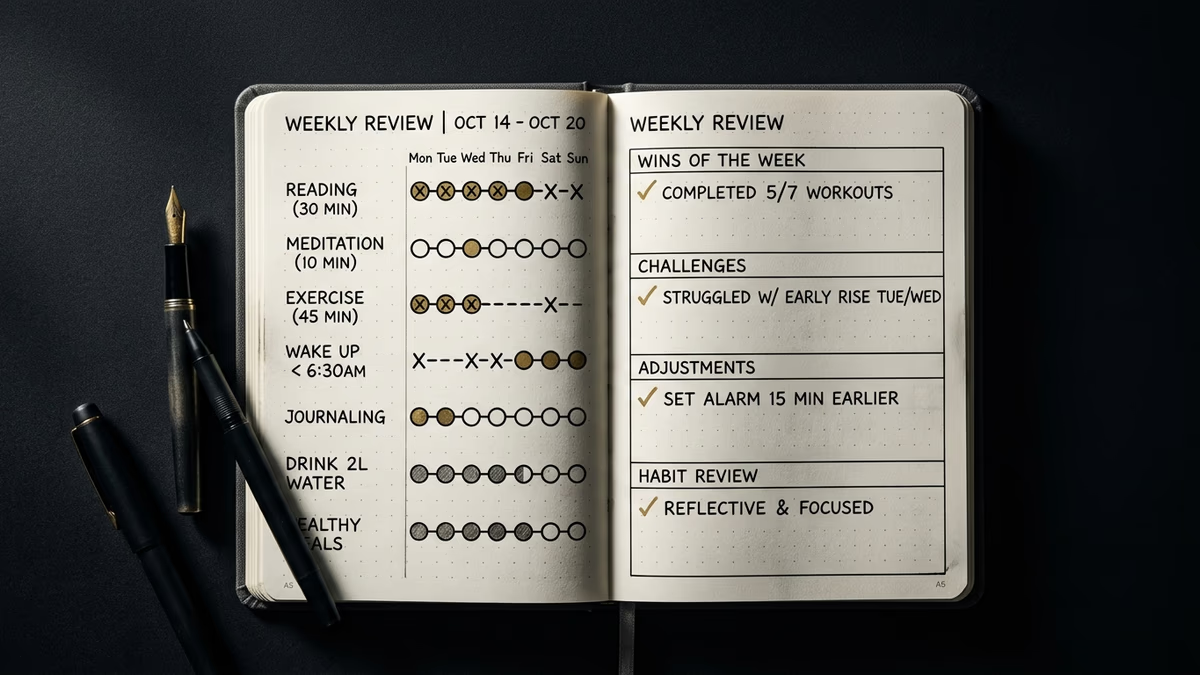
A routine without feedback becomes a routine that silently drifts. The weekly review closes the feedback loop.
Set aside 15 to 20 minutes every Sunday. You are not planning your whole week in detail. You are doing three things.
- Review last week's habits. Which hit? Which missed? Was the miss a one-off or a pattern?
- Identify one adjustment. Not five. One. The smallest change that would fix the biggest gap.
- Write Monday's plan now. List your top priorities and your key if-then plans before the week starts.
A meta-analysis of 138 studies by Harkin et al. (2016, Psychological Bulletin) found that prompting people to monitor their goal progress reliably increased the rate at which they attained those goals. The specific tool matters less than the act of reviewing. A paper notebook works as well as any app.
Protect Your Routine When Life Gets Hard
Travel, illness, a bad week at work. Every routine gets disrupted. The ones that survive are the ones with a pre-planned fallback.
The 50 Percent Rule
When disruption hits, do not skip. Do a reduced version instead. If your workout is 60 minutes, do 30. If your morning routine takes an hour, do the 15-minute version. Showing up at 50 percent keeps the identity vote alive. Zero breaks the chain entirely.
Research on the what-the-hell effect shows that treating a single miss as a failure leads to a complete collapse of behavior. Restrained dieters who believed they broke their diet in a taste test ate significantly more in a subsequent test than those who had no diet rules at all. One lapse became permission to abandon the system. Do not give yourself that permission.
Use Temporal Landmarks to Restart
When you do fall off, use a fresh temporal landmark to restart. Monday is the most powerful one. Research on the fresh-start effect shows that goal pursuit spikes after these landmarks: a new week, a new month, a birthday, the start of a new job. Use them deliberately. Do not wait until you feel like starting. Use the landmark as your trigger.
The Lock In Protocol
Your discipline routine is not a mood. It is an operating system. Stack habits onto existing anchors. Assign every behavior a specific cue. Run a weekly review to close the feedback loop. When disruption hits, execute a reduced version instead of nothing. Treat your routine like infrastructure: design it once, maintain it regularly, and trust it to run even when motivation is absent. The goal is not to feel disciplined. The goal is to have built a system that makes the right behavior the default.
Key Takeaways
- A routine is a chain, not a schedule. Each behavior triggers the next through stable cues and habit stacking.
- Automaticity takes 66 days on average. Plan in months. The 21-day rule is fiction.
- If-then plans are the highest-leverage tool. Writing "When X, I will Y" significantly raises follow-through with no extra effort.
- Weekly review prevents silent drift. 15 minutes every Sunday to track, adjust, and plan is enough to keep the system calibrated.
- Disruptions need a fallback, not a skip. A 50 percent version keeps the chain intact. Zero breaks it.
Frequently Asked Questions
How long does it take to build a discipline routine?
Research tracking 96 people over 84 days found the median time to automaticity was 66 days, with a range of 18 to 254 days depending on habit complexity. Plan in months, not weeks. The 21-day rule is a myth based on a misread anecdote from a 1960s plastic surgeon.
What is habit stacking?
Habit stacking means attaching a new behavior to an existing reliable habit. The formula is: after I do X, I will do Y. The established habit acts as a cue for the new one. This removes the need to remember and reduces friction by linking the new behavior to something already automatic.
Why does a weekly review help with consistency?
A weekly review closes the feedback loop. You see what worked and what did not, which lets you fix one small thing before the next week starts. Research on goal monitoring shows that people who track progress toward goals are significantly more likely to achieve them compared to people who set goals without tracking.
What should I do if I miss a day in my routine?
Get back to the routine at the very next opportunity. One miss is not a pattern. Research on the what-the-hell effect shows that treating a single lapse as a failure leads to a complete breakdown of behavior. The fix is to reframe the goal as long-term, not day-by-day perfection. Show up at 50 percent if needed, but show up.
How many habits should I add to my routine at once?
Start with one. Adding multiple habits at the same time splits your attention and makes it harder to build the stable cue-behavior connection each habit needs. Once one habit reaches automaticity, typically after 60 or more days, add the next.
References
- How habits are formed: modelling habit formation in the real world (European Journal of Social Psychology)
- Implementation intentions and goal achievement: a meta-analysis (Advances in Experimental Social Psychology)
- Monitoring goal progress: a meta-analysis (Psychological Bulletin)
- Habits in everyday life: thought, emotion, and action (Journal of Personality and Social Psychology)
- The what-the-hell effect: restrained eating and disinhibited intake (Journal of Personality)
- Temptation bundling and gym attendance (Management Science)
- The fresh-start effect: temporal landmarks and goal pursuit (Management Science)