To stop procrastinating, treat it as an emotional problem rather than a time problem: reduce the friction of starting so you can act for just two minutes, write if-then plans that pre-decide your response to distraction, and redesign your environment so that the productive choice is the easiest one.
Procrastination is not laziness. Research consistently shows people delay tasks because the brain treats aversive work as a threat and avoids it. You cannot think your way out of that. You have to design your environment and pre-plan your response so starting becomes automatic. This guide shows you exactly how, using tools backed by psychology.
Why You Procrastinate (And Why Willpower Fails)
Procrastination is widespread. In his meta-analytic review of 691 correlations, psychologist Piers Steel (2007, Psychological Bulletin) estimated that 15 to 20 percent of adults are chronic procrastinators, while 80 to 95 percent of college students procrastinate regularly. Steel frames it as “quintessential self-regulatory failure” — a failure of emotional regulation, not of time management. When a task feels boring, threatening, or overwhelming, your brain generates a negative emotion, and to escape it you turn to something easier: social media, snacks, or busywork.
The costs compound over time. In a classic longitudinal study, Tice and Baumeister (1997, Psychological Science) tracked students across a semester and found procrastinators felt less stress early on but ended the term with higher stress, more illness, and lower grades. Willpower alone cannot reverse that, because willpower is finite: the harder the task and the longer the day, the less you have. That is why systems built on “just do it” tend to collapse by Wednesday.
The Better Approach
- Reduce friction so starting the task costs almost nothing.
- Pre-plan your response to distraction with if-then plans.
- Redesign your environment so good behavior is the path of least resistance.
Reduce Friction: Make Starting Cost Nothing
The moment before starting is the hardest. Every extra step between you and the task is friction. Friction feeds procrastination. Your goal is to remove every obstacle between the cue and the action.
- Leave your document open on your screen before you close the laptop for the night.
- Put your gym clothes on the bathroom floor so you see them first thing.
- Have your book on your pillow so reading in bed is the default.
- Keep your work materials on the table so setup requires zero effort.
Behavioral economists Richard Thaler and Cass Sunstein call this “choice architecture”: small changes to the environment that shape behavior more reliably than motivation ever will. As they put it in Nudge (2008), “if you want to encourage some activity, make it easy.” You are not trying to want the task more. You are making the right action the path of least resistance.

The 2-Minute Start
Commit to only 2 minutes. Open the document and write one sentence. Start the warm-up, not the workout. Begin the first problem, not the entire exam. Research on task initiation shows that negative emotion around a task drops sharply within the first few minutes of working on it. The feeling that makes you procrastinate disappears once you begin.
You will almost always keep going past 2 minutes. But even if you stop there, you showed up. That repetition is what builds daily discipline.
Use If-Then Plans to Pre-Empt Distraction
An if-then plan — what researchers call an “implementation intention” — is a pre-made decision: you define your response to a trigger before the trigger happens. In a meta-analysis of 94 independent studies, Gollwitzer and Sheeran (2006) found that forming these plans had a medium-to-large effect on goal attainment (d = 0.65). Gollwitzer's own formulation is precise: “If situation Y is encountered, then I will initiate goal-directed behavior X.” They work best in exactly the high-temptation moments where in-the-moment decisions tend to fail.
“If [temptation or trigger], then I will [planned response].”
- “If I feel the urge to check my phone, I will place it face down and keep working for 5 more minutes.”
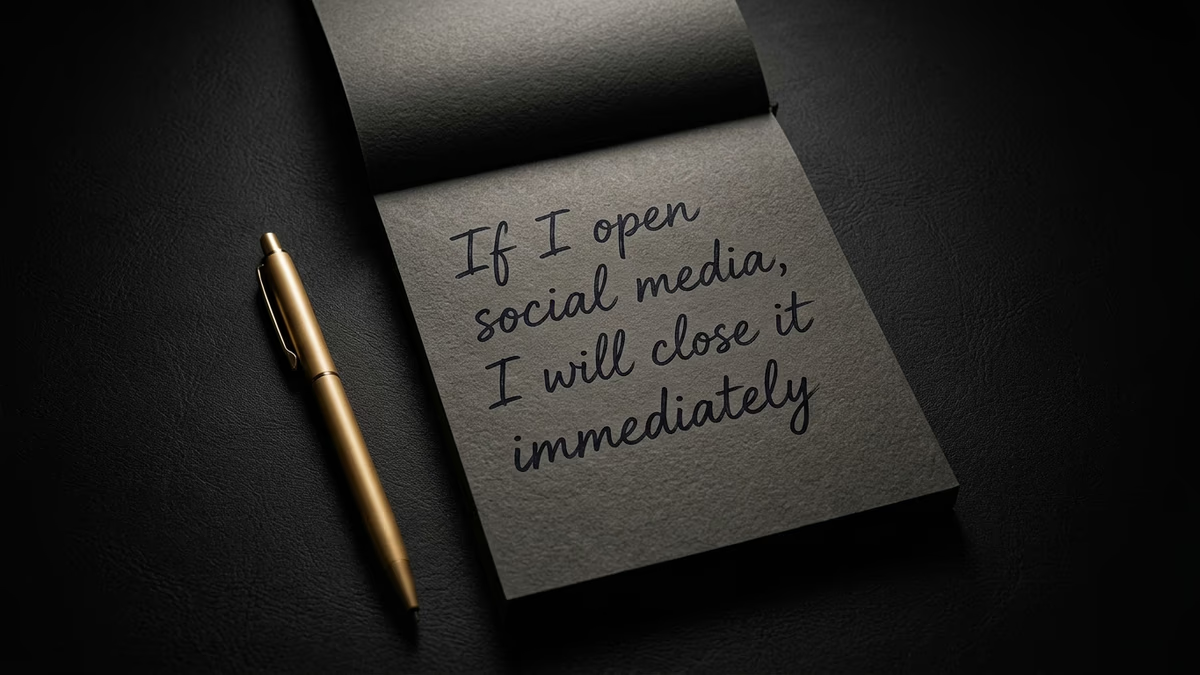
- “If I open social media, I will close it immediately and return to the task.”
- “If I feel like skipping my session, I will commit to just 2 minutes.”
- “If a non-urgent thought interrupts me, I will write it on a notepad and return to the task.”
The power of if-then plans is that you make the decision once, in a calm state, rather than in the moment when emotion is high. This removes the mental debate that procrastination thrives on.
Increase Friction for Distractions
Just as you reduce friction for productive tasks, you increase it for distractions. The goal is to make the default behavior switch from distraction to work.
- Log out of social media apps so opening them requires an extra step.
- Put your phone in another room during work sessions.
- Use a website blocker like Freedom or Cold Turkey during focused work.
- Remove visual cues for undesired behaviors. If snacks are on the counter, you will eat them. Put them away.
This works because so much of what we do runs on autopilot. In a diary study, Wood, Quinn, and Kashy (2002, Journal of Personality and Social Psychology) found that roughly 43 percent of participants' daily behaviors were habitual — repeated almost every day in the same physical location. As Wendy Wood puts it, habits are cued by context, so the most reliable way to weaken one is to change the cue. You are not fighting willpower. You are changing the architecture of the decision.
Your Work Environment Matters
A desk with only the tools you need for the task sends one clear signal to your brain. A desk with your phone, snacks, and open browser tabs sends many competing signals. Simplify the space. One task, one context, one cue.
The Lock In Protocol
Procrastination is a design problem, not a character flaw. Stop asking why you cannot motivate yourself. Start asking what obstacles exist between you and starting the task. Remove each one. Pre-plan your response to every predictable temptation. Then run the system. The 2-minute start is your first output. Friction reduction is your infrastructure. If-then plans are your failsafe. Build the machine and let it run.
Key Takeaways
- Procrastination is emotional, not about time. The brain avoids tasks that feel aversive. Willpower alone cannot fix this.
- Reduce friction to near zero. Every obstacle between you and starting the task feeds procrastination.
- Use the 2-minute start. Commit only to the first 2 minutes. The negative emotion drops once you begin.
- Pre-plan your response to distraction. If-then plans remove the in-the-moment decision that procrastination exploits.
- Increase friction for distractions. Log out, relocate your phone, remove visual cues. Make distraction harder than work.
Frequently Asked Questions
Why do I procrastinate even when I want to do the task?
Procrastination is primarily an emotional regulation problem, not a laziness problem. Research shows the brain treats aversive tasks the same way it treats physical threats. You avoid the task to escape the negative feeling associated with it, not because you do not care about the outcome.
What is an if-then plan and does it work?
An if-then plan is a pre-made decision that links a trigger to an action. Format: If [situation], then I will [behavior]. Multiple studies show if-then plans improve self-control performance, especially under high temptation. They work by removing the need to make a decision in the moment.
How do I make starting a task feel easier?
Reduce the startup cost. Open the file and write one sentence before you stop. Place your tools where you can see them. Commit to only 2 minutes. Research on task initiation shows that the discomfort of a task drops sharply once you begin. The hardest moment is the instant before starting.
Does environment really affect procrastination?
Yes, significantly. Research on habit formation shows behavioral cues in the environment shape whether we act automatically or resist. A desk with only work tools triggers work. A desk with your phone, snacks, and TV remote triggers distraction. Redesigning your space directly reduces procrastination without relying on willpower.
References
- Steel, P. (2007). The nature of procrastination: a meta-analytic and theoretical review of quintessential self-regulatory failure. Psychological Bulletin, 133(1), 65–94.
- Tice, D. M., & Baumeister, R. F. (1997). Longitudinal study of procrastination, performance, stress, and health. Psychological Science, 8(6), 454–458.
- Gollwitzer, P. M., & Sheeran, P. (2006). Implementation intentions and goal achievement: a meta-analysis of effects and processes. Advances in Experimental Social Psychology, 38, 69–119.
- Wood, W., Quinn, J. M., & Kashy, D. A. (2002). Habits in everyday life: thought, emotion, and action. Journal of Personality and Social Psychology, 83(6), 1281–1297.
- Uziel, L., Price, M., & Alquist, J. L. (2022). Desire for self-control and task performance: a plan is a key. Frontiers in Psychology, 13, 1011559.
- Procrastination as emotional regulation failure (Social and Personality Psychology Compass)
- Implementation intentions improve self-control under temptation (Utrecht University)
- Environmental cues and automatic behavior (Duke University)
- Choice architecture and behavior change (PMC)
- Building self-discipline: 7 proven strategies (COPE Psychology)

