To count macros, calculate your daily calorie need (TDEE) with the Mifflin-St Jeor equation, set protein to roughly 1.6 to 2.2 grams per kilogram of bodyweight, allocate the rest between carbs and fats, log the three macros daily, and adjust by 100 to 200 calories every two weeks based on results.
Counting macros treats your body as a system: measurable inputs, measurable outputs. The single highest-leverage number is protein. In a meta-analysis of 49 trials, Morton et al. (2018, British Journal of Sports Medicine) found protein intake supports added muscle from resistance training up to about 1.62 g/kg/day. This guide is general education, not personalized medical or dietary advice — consult a professional before making big dietary changes, especially with a medical condition.
Why Counting Macros Works Better Than Calorie Counting Alone

The distinction between macro tracking and simple calorie counting is profound. Both approaches create awareness of energy intake. However, macronutrient composition directly impacts body composition outcomes in ways that raw calorie counts cannot capture.
The advantage of macro tracking is what it does inside a calorie target: it protects muscle. In a tightly controlled trial of resistance-trained athletes during energy restriction, Longland et al. (2016, American Journal of Clinical Nutrition) found that under a steep deficit with hard training, the higher-protein group (about 2.4 g/kg/day) gained 1.2 kg of lean mass and lost 4.8 kg of fat, while the lower-protein group (1.2 g/kg/day) merely preserved its lean mass and lost less fat (3.5 kg). Same deficit, very different body composition.
This matters because preserving lean mass during a diet protects your resting metabolic rate and gives you a better foundation for long-term recomposition. Calorie counting alone leaves protein to chance; counting macros makes it a target you hit on purpose.
Higher-protein, lower-refined-carbohydrate patterns can also help with appetite control and blood-sugar management for some people, but the size of those effects varies and depends on the individual. If you manage a condition such as type 2 diabetes, treat macro targets as something to set with your clinician, not a substitute for medical advice.
Precision Planning: Engineering Your Daily Nutrition
Precision Planning represents the first pillar of systematic nutrition control. It involves calculating your exact nutritional requirements. Then you build a meal strategy that guarantees you hit those targets daily.
The process begins with determining your Total Daily Energy Expenditure (TDEE). This represents the total calories your body burns each day. It includes basal metabolism, digestion, and activity.
The Mifflin-St Jeor equation is the most widely validated formula. It calculates TDEE by first determining your Basal Metabolic Rate (BMR). BMR depends on your weight, height, age, and sex. Once your BMR is established, multiply it by an activity factor. This ranges from 1.2 (sedentary) to 1.9 (extremely active). Our calorie calculator runs both steps for you.
From your TDEE, you split calories into macronutrient targets. For body recomposition, research supports an approximate distribution. Use 30-35 percent carbohydrates, 30-35 percent protein, and 30-40 percent fats.
These percentages translate into concrete grams. If your TDEE is 2,000 calories, target roughly 150-175 grams of protein daily. This specificity eliminates guessing. You no longer wonder if you eat enough protein to support muscle growth. You know.
The Protein Priority
Protein deserves particular emphasis in precision planning. This macronutrient drives muscle protein synthesis. It controls hunger through enhanced satiety. It possesses the highest thermic effect of food (TEF).
As reviewed by Calcagno et al. (2019, Journal of the American College of Nutrition), roughly 20-30 percent of protein calories are burned during digestion (its thermic effect), compared with about 5-10 percent for carbohydrate and 0-3 percent for fat. This means protein-rich diets modestly increase your daily energy expenditure. A practical baseline, supported by Morton et al. (2018), is 1.6-2.2 grams of protein per kilogram of body weight.
Weight Manipulation: The Three Variables You Control

Weight Manipulation describes your ability to raise and lower body weight at will. You do this through deliberate adjustment of caloric intake, macronutrient ratios, and timing. Your body weight is not a fixed outcome. It is a controllable output determined by three primary input variables: calories, macronutrient ratios, and training stimulus.
The Caloric Deficit (Fat Loss State)
When you consume fewer calories than your body expends, it accesses stored fat for energy. A moderate deficit of 300-500 calories daily produces weight loss. This minimizes metabolic adaptation.
This deficit must pair with adequate protein intake and resistance training. Without protein and strength stimulus, your body preferentially loses muscle alongside fat. With them, fat loss becomes selective.
The Caloric Surplus (Muscle Gain State)
Conversely, a surplus of 300-500 calories above maintenance provides energy for muscle protein synthesis. It enhances performance during training. A modest surplus coupled with resistance training consistently produces superior muscle gains.
The quality of surplus matters. Polyunsaturated fats are more likely to promote lean mass gains compared to saturated fat. A strategic surplus is not permission to eat indiscriminately. It is a controlled state designed to maximize anabolic response while minimizing unnecessary fat gain.
The Recomposition Protocol
The most elegant variable manipulation involves body recomposition. This means maintaining a caloric deficit or maintenance state while driving muscle gain. You accomplish this through resistance training, adequate protein, and strategic carbohydrate intake.
A moderate deficit permits muscle gain if these conditions are met. Target 0.5-1.0 pound weekly weight loss. Your body preferentially mobilizes fat stores when protein and training stimulus are present.
The Tracking Workflow: Variables, Tools, and Operational Steps
The Tracking Workflow is the operational discipline that transforms calculations into results. It specifies exactly what you track, which tools enable accuracy, and the daily protocol you follow.
The Three Core Variables to Count
You track only three metrics daily when counting macros: protein (in grams), carbohydrates (in grams), and fats (in grams). These three macronutrients comprise virtually all the energy in your food. Micronutrients matter for health, but macronutrient precision is non-negotiable for body composition control.
Reading Labels and Building a Database
The first operational step is mastering nutrition labels. Every packaged food displays serving size, total calories, and macronutrient breakdown. For unpackaged foods (chicken breast, rice, vegetables), consult online databases like the USDA Food Data Central.
MyFitnessPal contains over 18 million verified foods. Cronometer prioritizes accuracy by requiring users to submit photos of nutrition labels before adding new items. MacroFactor hosts over 3 million verified items.
The Logging Protocol
Each meal, record the foods consumed and their quantities. Tools streamline this process. Barcode scanners photograph nutrition labels for instant data entry. Apps like Goldi AI use artificial intelligence to analyze food photos. Once logged, the app sums your daily intake against your targets.
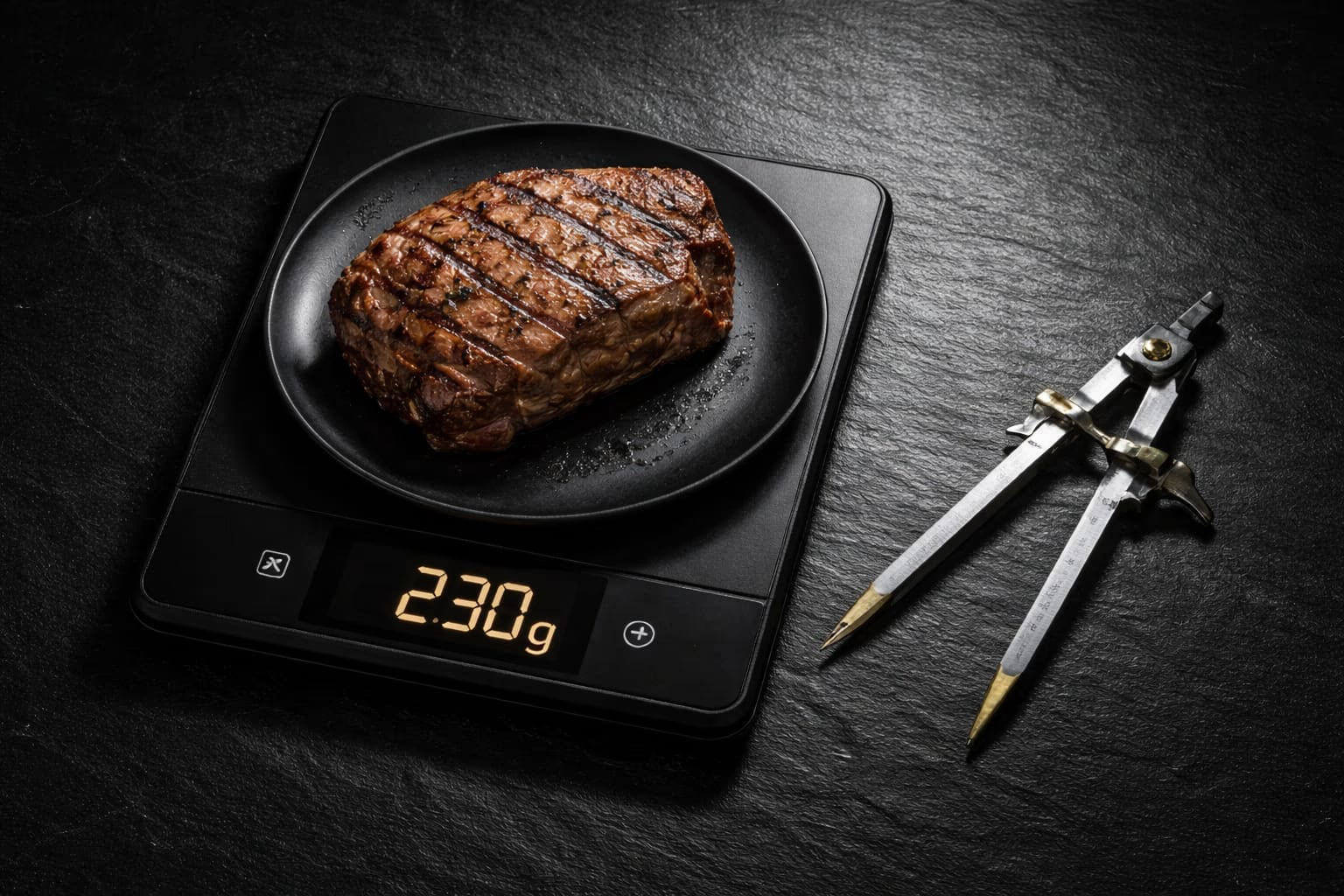
Research on tracking accuracy reveals that initial precision is critical. However, spot-checking suffices after you develop intuition. A typical protocol involves meticulous measurement and logging for the first two to three weeks. Use a digital food scale to weigh portions precisely.
The Hand Portion Alternative

For individuals preferring flexibility over absolute precision, the hand-portion method (popularized by Precision Nutrition) offers a practical shortcut: your palm sets a protein portion, a cupped hand a carbohydrate portion, a fist a vegetable portion, and your thumb a fat portion. The portions scale with your body because your hand does.
The hand method is an estimate, not a measurement — Gibson et al. (2016, Journal of Nutritional Science) found hand-based estimates landed within ±25 percent of true weight for about 80 percent of geometrically shaped foods, far better than household measures but less exact than a scale. Use it for adherence, and spot-check with a scale when precision matters. For a complete guide on applying this method to real meals, see our Making Meals guide.
The Lock In Protocol: Engineering Mastery
The Lock In Protocol embodies the engineering mindset: data-driven adjustments, strict order of operations, and relentless execution of non-negotiables. Every two weeks, review your weight, body composition, and gym performance, and treat your macro targets as hypotheses tested against real-world outcomes: if weight isn't moving, adjust the deficit by 100-200 calories; if strength is declining, add 20-30g of carbs. The order of operations is fixed: establish TDEE from your actual two-week weight trend, set protein to 1.8-2.2g/kg, allocate 0.8-1.0g/kg to fats, then assign the rest to carbs. Three elements are non-negotiable: hit your protein target, train with resistance at least three times weekly, and track consistently. The tools are minimal (a food scale, a tracking app, a spreadsheet); the real capital is the discipline to operate with precision through two-week feedback cycles even when progress stalls.
Key Takeaways
- Counting macros adds muscle protection to calorie control. Hitting a protein target preserves lean mass during a deficit, as Longland et al. (2016) showed.
- Calculate your TDEE first. Use the Mifflin-St Jeor equation based on weight, height, age, and activity level.
- Set protein to 1.6-2.2g per kg bodyweight. This is non-negotiable for muscle preservation and satiety.
- Track three variables: protein, carbs, and fats. Use apps like MyFitnessPal or MacroFactor for logging.
- Adjust every two weeks based on data. Change calories by 100-200 if progress stalls.
- Deficits and surpluses should be moderate. Use 300-500 calorie adjustments for sustainable results.
Frequently Asked Questions
How quickly will I see results from counting macros?
Measurable fat loss typically begins within 7-10 days of establishing a consistent deficit. Initial weight loss includes water and glycogen depletion. Meaningful body composition changes emerge over 4-6 weeks. Patience is the engineered response to slow progress. Metabolic adaptation naturally slows weight loss over time. This requires periodic adjustments to deficits rather than abandonment of the approach.
Can I eat any foods as long as I hit my macro targets?
Technically yes. Macro targets ensure adequate protein, energy balance, and nutrient ratios. However, food quality modulates satiety, micronutrient density, and overall health. Prioritize whole foods, lean proteins, and vegetables to fill your macros first. Use processed foods to fill remaining gaps when convenient.
How do I adjust my macros if I hit a weight loss plateau?
After two weeks of no progress, reduce calories by 100-200. Re-run the calorie calculator too, since a lighter body burns less than it did at the start. Most commonly reduce carbohydrates or fats while preserving protein. If hunger becomes intolerable, consider carb or calorie cycling. Plateaus are not failures. They are your body's adaptation response. Treat them as data points requiring adjustment.
References
- Morton, R. W., et al. (2018). A systematic review, meta-analysis and meta-regression of the effect of protein supplementation on resistance training-induced gains in muscle mass and strength in healthy adults. British Journal of Sports Medicine, 52(6), 376–384.
- Longland, T. M., et al. (2016). Higher compared with lower dietary protein during an energy deficit combined with intense exercise promotes greater lean mass gain and fat mass loss: a randomized trial. American Journal of Clinical Nutrition, 103(3), 738–746.
- Calcagno, M., et al. (2019). The thermic effect of food: a review. Journal of the American College of Nutrition, 38(6), 547–551.
- Gibson, A. A., et al. (2016). Accuracy of hands v. household measures as portion size estimation aids. Journal of Nutritional Science, 5, e29.
- Frankenfield, D., Roth-Yousey, L., & Compher, C. (2005). Comparison of predictive equations for resting metabolic rate in healthy nonobese and obese adults: a systematic review. Journal of the American Dietetic Association, 105(5), 775-789.
- Body recomposition diet strategies (Naked Nutrition)
- Nutrition's impact on body composition (Measure Up)
- Thermic effect of food: protein guide (Reshape App)
- Metabolic adaptation during calorie restriction (PMC)
- Non-exercise activity thermogenesis (NEAT) (PMC)
- Calorie surplus vs deficit explained (PT Workspace)
- Energy surplus for muscle gain, including the effect of fat type (PMC)
- Body recomposition protocol guide (MacroFactor)
- Best macro tracking apps comparison (Kate Lyman Nutrition)
- AI-powered macro tracking apps (Goldi AI)
- Hand portion math for tracking macros (Precision Nutrition)
- Should you track your macros? (Precision Nutrition)