
To build discipline daily, stop relying on motivation and build a cue-based system instead: pick one small behavior, attach it to a stable daily cue with an if-then plan, repeat it in the same context, and track one metric weekly until the action becomes automatic.
Discipline is not a personality trait. It is a skill built through repetition in a stable context. In a real-world study tracking 96 people for 84 days, Lally and colleagues (2010, European Journal of Social Psychology) found a behavior took a median of 66 days to become automatic. Motivation cannot carry you that far, so you build a system that does not need it. This guide shows you exactly how.
What Discipline Actually Is
Most people think discipline means forcing yourself to do hard things. That is wrong. In two experiments in Frontiers in Psychology (2022), Uziel, Price, and Alquist found that people who wished for more self-control performed better on self-control tasks once they had an if-then plan. The plan did the work, not raw willpower.
The strongest predictor of consistent behavior is not how much you want something. It is whether your environment and routine make the behavior easy to start. In a diary study, Wood, Quinn, and Kashy (2002, Journal of Personality and Social Psychology) found that roughly 43 percent of daily behaviors were repeated almost every day in the same location, cued by context, not decided in the moment. People who appear highly disciplined have usually just built better systems.
Discipline Is Not a Feeling
Waiting to feel ready is the trap. Discipline is an action, not a mood. The goal is to build routines so automatic that you act before your brain talks you out of it.
- Motivation gets you started once. Habit keeps you going every day.
- Willpower is a limited resource. Environmental design is not.
- Repetition in stable contexts turns effortful acts into automatic ones.
Start Smaller Than You Think You Should
The biggest mistake people make is going too hard too fast. They commit to an hour of work every morning, burn out in a week, and quit. In the same 84-day study, Lally et al. (2010) found automaticity rose with the number of repetitions, not their size, and that missing one occasional day did not measurably hurt the process. The goal at the start is not performance. It is repetition.
Shrink the task until you can do it on your worst day. If you want to build a daily writing habit, start with two minutes. If you want to exercise, start with five minutes. The session length does not matter yet. Showing up does.

The Two-Minute Rule in Practice
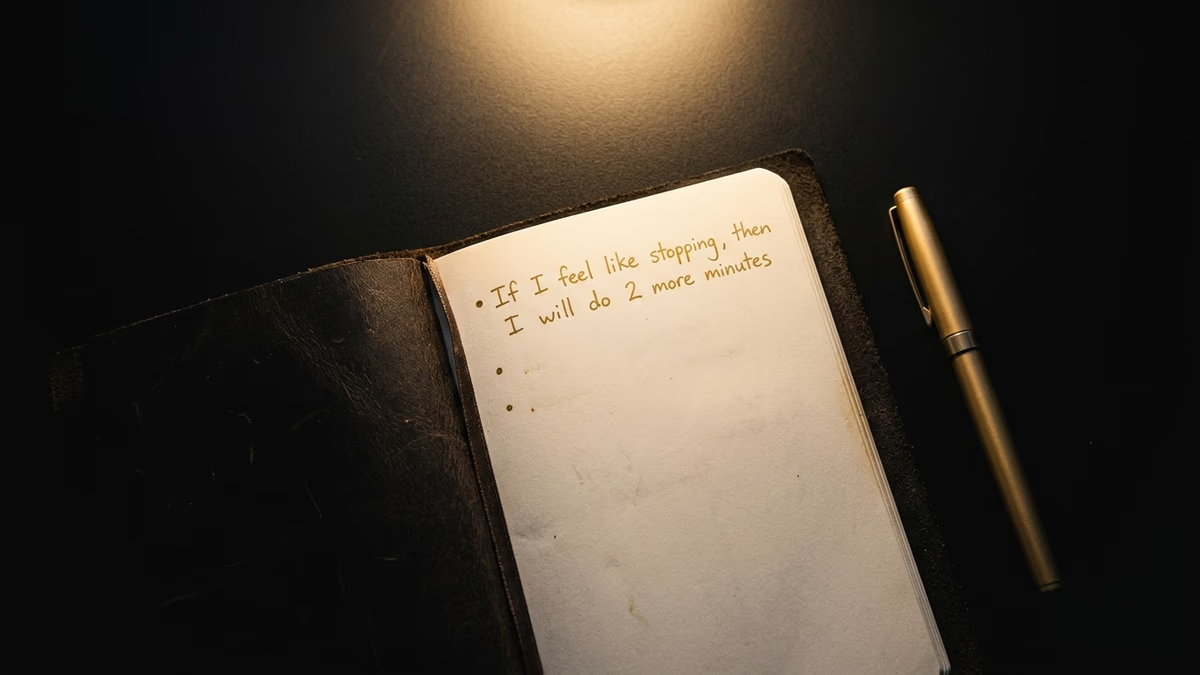
Commit to just two minutes of your target behavior. Once you start, you will usually keep going. But even if you stop at two minutes, you still showed up. That is the win. Over weeks, those two-minute sessions become ten, then thirty. The habit loop is already running.
Frame every session as a success to repeat, not a performance to judge. Discipline grows through repeated action, not heroic effort.
Make Your Habit Cue-Based
A cue is a trigger that fires the habit automatically. Research from Duke University found that over 40% of daily actions are habits driven by situational cues, not conscious decisions. The key is to attach your new behavior to an existing, reliable part of your day.
- After I make my morning coffee I will write for 10 minutes.
- After I shut my laptop at 6PM I will go for a walk.
- After I brush my teeth I will read for 15 minutes.
This is called habit stacking. You borrow the automaticity of an existing routine and attach your new behavior to it. Over time, the cue becomes enough to trigger action without conscious thought.
Write Your If-Then Plan
Writing a specific plan dramatically improves follow-through. In a meta-analysis of 94 independent studies, Gollwitzer and Sheeran (2006) found that forming these “implementation intentions” had a medium-to-large effect on goal attainment (d = 0.65). Use this template:
“If [cue], then I will [specific behavior].”
Example: “If I make my morning coffee, then I will sit at my desk and write for 10 minutes.” That specificity removes the decision. When the cue fires, you already know what to do.
Track One Metric Every Week
- Streak: How many consecutive days did you complete the behavior?
- Sessions: How many times did you complete it this week?
- Minutes: Total time spent on the behavior this week.
Tracking does two things. It makes your progress visible, which feels rewarding. And it surfaces patterns in when you usually miss, so you can fix the environment before it becomes a collapse.
Review your number every Sunday. If you missed more than once, identify the trigger. Was the cue unreliable? Was the task too big? Adjust one variable and restart.
The Lock In Protocol
Treat building discipline like engineering a system. You have inputs and outputs. The input is your cue plus your if-then plan. The output is the completed behavior. Your job is not to try harder. Your job is to remove every obstacle between the cue and the action. Reduce friction. Fix the environment. Run the system. Repeat until it is automatic.
Key Takeaways
- Discipline is a skill, not a trait. It is built through repeated action in stable contexts, not willpower.
- Start smaller than feels right. The goal is repetition first. Performance comes later.
- Attach behavior to a reliable cue. Borrow automaticity from an existing daily routine.
- Write a specific if-then plan. "If [cue], then I will [behavior]" dramatically improves follow-through.
- Track one metric weekly. Make consistency visible and adjust when you see slip patterns.
Frequently Asked Questions
How do I build discipline without motivation?
Stop relying on motivation. It is unreliable. Instead, use cue-based habits and if-then plans. When a trigger fires, you act. No motivation needed. Research shows that habits formed around stable cues become automatic over time.
How long does it take to build a discipline habit?
Research shows habit automaticity develops over 18 to 254 days depending on the behavior and person. Simpler behaviors become automatic faster. The key is consistent repetition in the same context, not a fixed number of days.
What is the best daily routine for building discipline?
Start with one anchor behavior tied to an existing cue. After coffee, write for 10 minutes. After you shut your laptop, walk for 15 minutes. Morning and evening anchor routines work well because these times are consistent. Build from one habit before adding more.
Should I track my discipline habit?
Yes. Tracking one simple metric, like a streak or number of completed sessions, makes your progress visible. This reinforces the habit and helps you catch slip patterns before they compound.
References
- Lally, P., van Jaarsveld, C. H. M., Potts, H. W. W., & Wardle, J. (2010). How are habits formed: modelling habit formation in the real world. European Journal of Social Psychology, 40(6), 998-1009.
- Wood, W., Quinn, J. M., & Kashy, D. A. (2002). Habits in everyday life: thought, emotion, and action. Journal of Personality and Social Psychology, 83(6), 1281-1297.
- Gollwitzer, P. M., & Sheeran, P. (2006). Implementation intentions and goal achievement: a meta-analysis of effects and processes. Advances in Experimental Social Psychology, 38, 69-119.
- Uziel, L., Price, M., & Alquist, J. L. (2022). Desire for self-control and task performance: a plan is a key. Frontiers in Psychology, 13, 1011559.
- Environmental cues and automatic behavior (Duke University)