
In 75 Hard vs 75 Soft, most people should pick the softer side: 75 Soft or 75 Medium. Pick 75 Soft if a daily workout is new to you. Pick 75 Medium if you already train a few times a week. 75 Hard only fits if you already train every day and want a pass or fail test.
Two things decide it: the training load and the missed day. 75 Hard asks for 630 minutes of training a week, and one missed task sends you back to day one. 75 Soft asks for 270 minutes, and a miss does not reset the count. 75 Medium sits between them. Cleveland Clinic calls 75 Soft safer and more manageable than 75 Hard for many people.
75 Hard vs 75 Soft vs 75 Medium: The Full Table
All three run for 75 days, which is 10 weeks and 5 days. 75 Soft and 75 Medium are the two easier versions of 75 Hard. The table includes training minutes a week, rest days, water in both units, and the missed day rule.
| Rule | 75 Hard | 75 Medium | 75 Soft |
|---|---|---|---|
| Daily rules | Five | Six | Four |
| Workouts | Two 45 minute sessions a day, one outdoors | One 45 minute session a day | One 45 minute session a day |
| Rest days | None | None | One active recovery day a week |
| Training a week | 630 minutes | 315 minutes | 270 minutes, plus the recovery day |
| Training over 75 days | 150 sessions, 112.5 hours | 75 sessions, about 56 hours | About 64 sessions, 48 hours |
| Water | 1 gallon (128 oz, 3.8 liters) | Half your body weight in pounds, as ounces. At 160 pounds: 80 oz (2.4 liters) | 3 liters (101 oz) |
| Diet | A diet of your choice, no cheat meals | A diet of your choice, 90 percent of the time | Eat well in general |
| Alcohol | None | None in most versions | Social occasions only |
| Reading | 10 pages of nonfiction, printed book | 10 minutes, audio counts | 10 pages of any book |
| Mindfulness | Not a rule | 5 minutes of meditation or prayer | Not a rule |
| Photos | Every day | Day 1 and day 75 | Not a rule |
| Missed day | Restart from day one | No restart | No restart |
| Official rules | Yes. Andy Frisella's program, from 2019 | No official version | No official version |
The 75 Hard and 75 Soft columns follow the rule lists published by Cleveland Clinic. 75 Medium has no official version, so its column shows the most common one. 75 Hard is Andy Frisella's program and its name is a trademark. This site is not affiliated with it.
Read the training rows first. The World Health Organization recommends 150 to 300 minutes of moderate activity a week for adults. 75 Soft sits inside that range and 75 Medium sits just above it. 75 Hard asks for more than double the top of it, with no rest day. The range is a recommendation, not a ceiling, but it shows the size of the step.
The water row holds a surprise. Below about 200 pounds of body weight, 75 Medium asks for less water than 75 Soft.
Each pair, in one line:
- 75 Soft vs 75 Hard: 270 against 630 minutes a week, and no restart against a restart. The widest gap.
- 75 Hard vs 75 Medium: a similar daily list with half the training and no restart.
- 75 Medium vs 75 Soft: 45 more minutes a week, a counted diet, and a meditation rule.
The Rule That Really Separates Them: The Missed Day
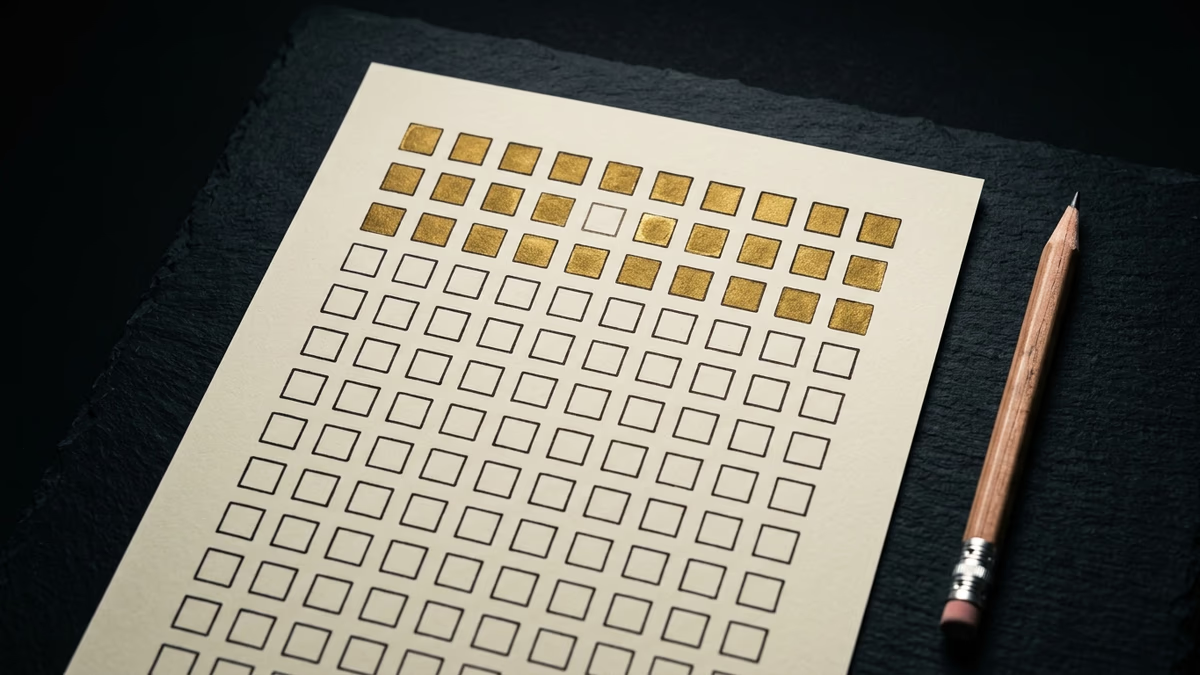
What one missed task costs is the real difference between the three. On 75 Hard, any miss sends you back to day one. On 75 Soft and 75 Medium, you log it and keep counting.
That cost grows as you go. A miss on day 5 of 75 Hard costs you 5 days. A miss on day 60 costs you 60.
What Research Says About a Missed Day
The best known habit study does not support the restart. In that 12 week study, 96 volunteers each repeated one new daily behavior. It took a median of 66 days to become automatic. Missing one opportunity did not materially affect the process.
Diet research points the same way. One study covered 54,517 people in a weight reduction program. It compared rigid, all or nothing control of eating with flexible control. Flexible control was associated with lower body mass index and less binge eating. It also came with a higher chance of successful weight reduction over one year. Rigid control was associated with more binge eating.
Those are associations, not proof of cause, and the study did not test these challenges. Still, both studies point one way: a rule that forgives one miss is not the weaker rule. A sports performance psychologist at Cleveland Clinic also sees little to no scientific evidence that 75 Hard is beneficial. If you want the restart anyway, treat it as a test you choose.
Which One to Pick: Find Your Situation
Find the line that describes you. If two lines fit, take the easier challenge.
- You have never trained daily: 75 Soft. If 45 minutes is new, build up first. An exercise physiologist at Penn State suggests 15 minutes a day, five days a week, for four weeks.
- You train three or four times a week: 75 Medium. Make two of the seven sessions easy ones.
- You already train every day and want a pass or fail test: 75 Hard. Read the fine print on the 75 Hard rules page first.
- You failed 75 Hard before: 75 Medium. It keeps the daily structure and drops the restart.
- You work shifts or have small children: 75 Soft. You need one 45 minute slot a day, not two. Put the lighter recovery day on your worst day of the week.
- You want 75 days without alcohol: 75 Hard or 75 Medium. 75 Soft allows drinks on social occasions.
- You want a summer run: 75 Soft or 75 Medium, because a travel day or a wedding will not reset the count. A start on June 1, 2027 ends on August 14, 2027.
- You want to write your own rules: none of the three. See the alternatives below.
This page is not medical advice. Talk to a doctor before you start if you have a medical condition or are pregnant. The same goes for a history of disordered eating.
Stepping Down and Stepping Up
The three challenges form a ladder. Step down after a failed run and step up after a finished one. Move one step at a time.
After Failing 75 Hard Twice
Stop restarting and step down to 75 Medium. Two failed runs are data. Find the task that broke both runs, because 75 Medium changes exactly those tasks:
- The second workout broke it: 75 Medium removes it. Your week drops from 630 to 315 minutes.
- The diet broke it: 75 Medium asks for 90 percent. With three meals a day, that is 19 of 21 meals a week.
- One bad day broke it: 75 Medium has no restart. Log the day and never miss twice.
Finish 75 days once before you try 75 Hard again. If one miss turns into a week off, the recovery protocol covers the first 24 hours after a lapse.
When to Move From 75 Soft to 75 Medium
Move up after one finished 75 Soft with at least 68 complete days out of 75. That is the 90 percent line. Below it, run 75 Soft again. The step is small in training and larger in rules:
- Training: 270 to 315 minutes a week. The recovery day becomes a seventh session, which can be an easy one.
- Diet: from eating well in general to a counted 90 percent.
- Alcohol: from social occasions to none in most versions.
- New rules: 5 minutes of meditation or prayer, and a photo on day 1 and day 75.
The step from 75 Medium to 75 Hard is far bigger. Training doubles from 315 to 630 minutes a week, and the restart rule arrives. Test two sessions a day for two weeks before you start the count.
75 Hard Alternatives Outside the 75 Family
75 Soft and 75 Medium are variations of 75 Hard, and all three hand you a fixed rule list. If you want challenges like 75 Hard without the fixed list, these alternatives let you set the rules yourself.
- The winter arc: a season from October 1 to December 31, 92 days long. You write three to five rules and hold them to the end of the year. The winter arc challenge lays it out as a 13 week plan.
- The Great Lock In: the same idea with September added. The Great Lock In runs from September 1 to December 31, which is 122 days.
- Monk mode: not a fitness challenge. Monk mode is a fixed period in which you remove distractions to work on one goal.
- A 30 day test run: there is no agreed 30 day version, and sites that offer one write their own rules. For a first try, hold the rule list you picked for 30 days.
Winter Arc vs 75 Hard
The winter arc is a season with rules you write. 75 Hard is a program with rules you are given. They differ on three points:
- Rules: three to five you write yourself, against five fixed daily tasks.
- Dates: October 1 to December 31, against any 75 days you choose.
- A missed day: log it and never miss twice, against a restart from day one.
You can run both at once. A 75 day challenge that starts on Sunday, October 18, 2026 ends on Thursday, December 31. That is the last night of the winter arc. Start later and day 75 falls in January. The winter arc page has the full table, with the Great Lock In as a third column.
How to Choose and Lock It In
Decide once, in writing, before day one. Five steps:
- Count your training minutes. Set last week's total against 630, 315 and 270.
- Decide the missed day rule. A restart means 75 Hard. No restart means 75 Medium or 75 Soft.
- Find your situation in the list above.
- Fix both dates. Day 75 is your start date plus 74 days.
- Write it down and track it daily.
Copy this sheet and fill it in:
The 75 challenge tracker page has printable trackers for all three, a checklist, and an end date calculator. Then read the fine print for your pick: the 75 Hard challenge, the 75 Medium challenge, or the 75 Soft challenge.
The Lock In Protocol
Choose by numbers, not by mood. Count the minutes you trained last week and set them against 630, 315 and 270. Decide the missed day rule before day one and write it down. Then mark every rule kept or missed each day. If a run fails, step down one level and finish 75 days before you step back up.
Key Takeaways
- Most people should pick 75 Soft or 75 Medium. 75 Hard only fits if you already train every day and want a pass or fail test.
- The missed day rule is the real difference. 75 Hard sends you back to day one after any missed task. 75 Medium and 75 Soft keep counting.
- The training load is 630, 315 and 270 minutes a week. The World Health Organization recommends 150 to 300 minutes of moderate activity for adults.
- Move one step at a time. After two failed runs of 75 Hard, step down to 75 Medium. Move from 75 Soft to 75 Medium after a finished run with 68 of 75 complete days.
- You can also write your own rules. The winter arc runs from October 1 to December 31, and a 75 day run started on October 18, 2026 ends on the same night.
Frequently Asked Questions
What is the difference between 75 Hard and 75 Soft?
75 Hard vs 75 Soft comes down to training load and the missed day rule. 75 Hard asks for two 45 minute workouts a day, a gallon of water, a strict diet with no alcohol, ten pages of nonfiction and a daily photo. Any missed task restarts the count. 75 Soft asks for one 45 minute workout with one active recovery day a week, 3 liters of water, eating well and ten pages of any book. A missed day does not restart it.
Which is easier: 75 Soft or 75 Medium?
75 Soft is the easiest of the three. It has four rules, 270 minutes of training a week and one active recovery day. 75 Medium has six rules, 315 minutes a week and no rest day, and it counts the diet at 90 percent. 75 Hard is the hardest, at 630 minutes a week with a restart after any miss.
Which 75 challenge is best for beginners?
75 Soft. It is the only one of the three with a weekly recovery day, and a missed day does not reset the count. If a 45 minute workout is new to you, build up first. An exercise physiologist at Penn State suggests starting with 15 minutes a day, five days a week.
What is the difference between 75 Medium and 75 Soft?
75 Medium trains every day, 315 minutes a week. 75 Soft has one active recovery day and 270 minutes. 75 Medium counts the diet at 90 percent and rules out alcohol in most versions. 75 Soft says to eat well and allows drinks on social occasions. 75 Medium also adds five minutes of meditation or prayer and two photos. Neither has an official rule list, and neither restarts after a miss.
Can you switch from 75 Hard to 75 Soft in the middle of the challenge?
You can, but the switch ends your 75 Hard. Its rules treat any missed task as a restart from day one, and a lighter day is a miss. 75 Soft and 75 Medium have no official rules, so nothing stops you from keeping your day count under the new list. Write down the switch date and the new rules, and do not switch a second time.
Is the winter arc the same as 75 Hard?
No. The winter arc is a season from October 1 to December 31 with three to five rules you write yourself and no restart. 75 Hard is a 75 day program with five fixed daily tasks and a restart after any miss. A 75 day challenge that starts on October 18, 2026 ends on December 31, so you can run one inside the other.
References
- The 75 Hard Challenge: rules, origin and risks, reviewed by a sports performance psychologist (Cleveland Clinic, September 2025)
- The 75 Soft Challenge: the four rules and why a missed day needs no restart (Cleveland Clinic, November 2023)
- The 75 Medium Challenge reviewed by a sports medicine physician: common rules, benefits and risks (Cleveland Clinic, July 2026)
- The Medical Minute: 75 Hard, 75 Soft and how to keep your fitness resolutions, with a clinical exercise physiologist (Penn State Health News, January 2024)
- Lally, van Jaarsveld, Potts and Wardle. How are habits formed: Modelling habit formation in the real world. European Journal of Social Psychology, 2010.
- Westenhoefer, Stunkard and Pudel. Validation of the flexible and rigid control dimensions of dietary restraint. International Journal of Eating Disorders, 1999 (PubMed)
- World Health Organization 2020 guidelines on physical activity and sedentary behaviour (PubMed)

